In an era dominated by Industry 4.0, smart factories, and servo-driven automation, it would be easy to assume that traditional mechanical indexing systems have become obsolete. Especially with the advances of servo motor technology, which has transformed many areas of industrial automation.
However, the flexibility, programmability and rapid reconfiguration that servo motors can deliver have little impact on dedicated production lines manufacturing the same product day after day. Particularly within the can-making industry where mechanical indexing technology continues to offer compelling advantages that modern electronic systems often struggle to match.
For instance, when machines operate consistently around the clock producing thousands of identical components every hour with the process rarely changing, speed, accuracy, reliability and uptime become more important than machine flexibility. This is where mechanical indexing excels, as a HEINZ mechanical indexer converts continuous rotary input from an electric motor into precise intermittent motion. This allows products to move through a series of stepped manufacturing processes, positioning components accurately at each station before rapidly indexing to the next operation. The result is a highly repeatable and dependable motion profile that can operate continuously for years with minimal adjustment.
In applications such as FMCG packaging, where production processes remain unchanged throughout the machine’s life, servo systems can introduce unnecessary cost and complexity. Whereas many mechanical indexing installations can remain operational for decades, often requiring little more than routine lubrication and scheduled maintenance.
Enabling CMbE to deliver exceptional production rates, repeatability and long-term reliability
To achieve optimal performance of the CarnaudMetalbox machine, careful specification of the indexing system was required. Working closely with HEINZ we were able to ascertain information on key factors such as indexing angle, input speed and duty cycle. Understanding these considerations meant that the mechanical indexer would be correctly sized and configured to match the application’s performance requirements.
As a leading systems integrator, we often combine high precision indexers alongside geared motors to deliver an optimal solution and technological advantage for applications requiring high precision, uniform incremental movements.In this case, a key component was the worm gearbox. The electric motor typically operates at a speed that is unsuitable for direct connection to the indexer, therefore the worm gearbox provided the necessary speed reduction while simultaneously increasing output torque.
The gearbox delivered a stable drive to the mechanical indexer, ensuring accurate indexing performance and helping maintain production consistency across extended operating periods.
For CMbE’s can manufacturing machinery, where uptime and repeatability are critical, this combination of electric motor, worm gearbox, and mechanical indexer provided a robust and proven solution.
We work across the spectrum and deliver solutions that best fit the needs of our customers, so rather than seeing one technology win out against the other, it’s very much down to application and the future is likely to involve a blend of technologies, with servo systems providing flexibility where required and mechanical indexers dominating fixed-process, high-volume production environments.
For manufacturers producing millions of identical components every year, the advantages remain clear:
Exceptional repeatability
High-speed operation
Long service life
Reduced complexity
Lower cost of ownership
When combined with correctly specified worm gearbox drives, HEINZ mechanical indexing equipment continues to offer a highly efficient and dependable solution for modern can manufacturing machinery.
As a specialist in powertrain systems and integration, we continue to support manufacturers with the expertise needed to specify, size, and supply the optimal gearbox and indexing solutions for demanding industrial automation applications. Delivering proven performance when productivity and reliability matter most.
This is an edited excerpt from the article: The enduring case for mechanical indexing. You can read the full article in the August edition of IPE.
And if you have a question on anything discussed here or would like to know more about our capabilities to support your next project, get in touch.
Centrifugal brakes provide automatic, speed-dependent deceleration without requiring external power.
It does so through a combination of centrifugal force and friction. As the rotational speed increases, internal weights (flyweights) are thrown outward, pressing friction linings against a stationary outer drum to slow the rotation.
Where are centrifugal brakes deployed?
As they require no external power source, centrifugal brakes inherently provide a fail-safe speed control, making them an ideal backup to electronically controlled spring-applied brakes where people or goods move.
Below are some key scenarios where they are beneficial:
Fall & Rescue Equipment: Used as automatic descenders for industrial abseiling, emergency escape systems and safety backups on climbing auto belays and zip lines.
Industrial Lifting: Serve as redundant, speed-regulating brakes on construction hoists, overhead cranes as well as elevators to prevent uncontrolled, catastrophic drops.
Marine & Energy: Regulate lowering speeds on lifeboat davits into water and emergency descent systems in wind turbines.
Security & Doors: To control the smooth, safe closing speed of heavy rolling security gates and fire-protection doors.
Reel Mechanisms: Prevent high-speed backlash in heavy-duty measuring tapes and self-retracting lifelines.
Through our decades of expertise in delivering brake systems and working with a wide range of customers we’re able to supply both bespoke brake systems as well as the Amsbeck range of centrifugal brake systems.
Since 1982, Amsbeck has been manufacturing safety braking systems to support the construction, agriculture and industrial machinery sectors. The family-owned business produces centrifugal clutches, centrifugal brakes, shifting clutches and push-on gears for OEMs. And we have worked together for a number of years to provide specialised braking systems when a precise speed control is required.
We’re also able to provide designed solutions that meet specific customer requirements, typically in applications such as abseiling equipment, rolling gates and elevators.
How to choose the right brake?
There are some key considerations we go through with our customers when selecting the ideal centrifugal brake to meet precise operational limits.
The first is to look at torque capacity as the brake must safely accommodate the maximum operational torque required by your system without slipping. Engagement speed is then also critical to verify that the brake triggers at the exact RPM necessary to keep your specific equipment safe or to function as an effective speed limiter.
Heat management is a key safety and durability consideration. Owing to the heavy friction-induced heat generated during operation the system must be capable of managing them without fading and premature wear.
Furthermore, modular and accessible brake designs allow for quick friction pad replacements and routine servicing which can minimise equipment downtime.
If you have a system that requires a proven method for controlling speed, that is cost-effective and can be designed to meet your exact requirements for safety and durability contact our team to discuss the right solution.
To support this, Curtis has developed and brought to market its F-series of controllers which represent a significant evolution of its widely used and proven over time E-series.
Here we look at some of the controllers’ key features and advantages over the E-series to provide guidance to those looking towards the next generation of motor controllers that have been designed to offer higher performance and efficiency and be more compact.
A controller that aligns with modern industry demands
Although the E-series was designed to meet the safety and performance standards of its time, today’s applications demand more. Therefore, the F-series is built to align with current trends in electrification, including stricter functional safety expectations, advanced diagnostics, and system-level integration.
In addition, modern OEMs require controllers that can seamlessly integrate into networked vehicle architectures. The F-series controllers support this by enabling better communication, real-time diagnostics, and centralised control across multiple subsystems.
Built on a significantly updated hardware and software architecture, compared to the legacy E-series, the F-series has more powerful processing platforms which supports a category 2 designated architecture for functional safety. This updated architecture also provides improved firmware (FOS – Function Operating System) and control algorithms.
This results in faster response times, improved control accuracy, and the ability to handle more complex applications. It also reflects the broader industry shift toward software-defined and networked vehicle systems.
Enhanced programmability and CAN Bus integration
One of the most important advancements in the F-series is its native CAN-based programmability, which addresses the shift from rigid, proprietary systems to flexible, interoperable, and intelligent networks.
So, unlike the E-series, which relies on older serial communication methods, F-series controllers:
Are fully programmable over CAN Bus
Support modern vehicle communication standards
Integrate seamlessly with other Electronic Control Units (ECUs)
The benefits of this are realised in easier system integration, faster commissioning and updates and improved diagnostics and fault tracing.
Additionally, tools such as the Curtis Integrated Toolkit (CIT) provide a centralised and user-friendly interface for configuration, monitoring, and tuning.
The scalability and system-level integration of the controllers across a wide range of applications and system roles makes them ideal for OEMs looking to standardise platforms across vehicle types as they can act as CAN masters or system managers. They can also operate as standalone controllers and co-ordinate multiple subsystems within a vehicle.
Greater system control capabilities
For OEMs looking to customise vehicle behaviour, the F-series controllers offer a much more advanced toolchain and programming model, enabling more flexibility and efficiency.
For instance, multiple functions can be handled within a single controller and complex control logic can be implemented onboard. Even development, testing, and troubleshooting are more streamlined, so there is a reduced dependency on external modules and overall system design is simplified.
A comprehensive vehicle system manager
Through its increased number of I/O (input/output) channels, which are more configurable, there is a reduced need for additional and costly control hardware. And as there is support for a wide range of sensors and actuators there is greater system flexibility and enables OEMs to design more feature-rich machines.
Furthermore, improved vehicle performance, energy efficiency, and overall user experience is delivered through the broad range of motor technologies that are supported. Such as AC induction motors, permanent magnet AC (PMAC) motors and brushless DC (BLDC) motors. Which provide higher efficiency, better torque control and a smoother operation.
Meeting advanced safety and serviceability requirements
F-Series controllers are and will be compliant with all incoming legislative changes in the Machinery Directive and the Cyber Resilience.To address applications that require higher reliability and compliance with modern safety standards the controllers have more advanced safety mechanisms. Such as some models are designed with dual-micro architecture to meet category 2 functional safety. They also benefit from improved fault detection and handling and therefore offer better support for system-level safety strategies.
Another key advantage of F-series controllers are its enhanced diagnostics capability delivered through its real-time system monitoring, detailed fault codes and logging and easier remote diagnostics via CAN. All of which reduces downtime, simplifies maintenance, and improves overall service efficiency.
A future-ready platform
As industries move toward more connected, software-driven systems, F-series controllers are better supported for new developments, more adaptable to evolving standards and much easier to update and extend compared to the E-series. For OEMs, this translates into longer product lifecycles and a reduced risk of obsolescence which can result in operational efficiency, safety, and financial performance.
For many years, the Curtis E-series controllers have served reliably. However, the F-series represents a significant step forward in controller technology and can reduce the risks associated with the legacy E-series.
Through modern architecture, advanced programmability, improved safety, and superior system integration, F-series controllers are better suited to meet the demands of today’s electrified and connected vehicle ecosystems. So, if you have a new project or upgrade you’d like to discuss get in touch with our team who have extensive knowledge and a strong partnership with Curtis.
Lead-acid batteries have been a dependable choice for decades. They are durable, robust, and inexpensive upfront, making them suitable for budget-conscious fleets.
However, they are heavier, slower to charge, and require regular maintenance, which can be a disadvantage in high-demand operations. That said it still has a practical role in specific applications.
Such as in counterbalance equipment, the battery weight contributes to machine stability, meaning a reduced need for additional steel or iron counterweights.
Lead-acid can accommodate a short burst of high current output needed for applications that require starter motors on larger engines, often needed for heavy duty work.
Lithium-Ion (Li-ion) Batteries
Lithium-ion batteries are rapidly becoming the preferred choice for industrial EVs due to their high energy density, lightweight design, and extended operational runtime. These batteries allow for fast and opportunity charging, keeping machines operational throughout the day with minimal downtime.
For smaller industrial equipment that doesn’t rely on battery weight for counterbalance, Li-ion offers additional advantages: less mass to carry reduces energy consumption, while smaller battery packs lower upfront costs.
However, safety and performance depend heavily on the Battery Management System (BMS). A high-quality BMS ensures thermal stability, battery integrity, and reliable operation, making it a critical component of any Li-ion system.
There are also competing lithium chemistries – such as Lithium Iron Phosphate (LFP) and Nickel Manganese Cobalt (NMC), and others. Each chemistry offers unique strengths in energy density, cost, safety, and lifecycle which therefore makes chemistry selection application specific.
Lithium Chemistries in Industrial Vehicles
Because of the different chemistries, not all Li-ion batteries are the same and offer distinct advantages and trade-offs. For this reason, selecting the right battery is crucial for forklifts, AGVs, warehouse robots, and other industrial EVs.
Applying our extensive knowledge of sourcing components for EV operated systems we’ve created the below table and bullets which summarises some of the key Li-ion chemistries with considerations around applications.
Chemistry
Pros
Cons
Best Applications
LiFePO4 (Lithium Iron Phosphate)
Very safe, long cycle life (2500+ C/D cycles), thermally stable, low maintenance
LiFePO4 and LTO dominate industrial applications due to their safety, long lifespan, and reliability, especially for indoor material handling.
NMC is suited for medium – to high-duty fleets, balancing energy and cost.
NCA fits heavy industrial EVs where high energy density is critical.
Selecting the right chemistry ensures optimised runtime, safe operation, and lower total cost of ownership, making it a critical decision for fleet managers and industrial operators.
Advanced and Emerging Technologies
In addition to the options already available, there are several next-generation battery technologies currently under research and development. These promise even greater efficiency, safety, and sustainability and include:
Solid-State Batteries: This technology replaces liquid electrolytes (which are flammable) with a solid material, offering higher energy density, reduced fire risk, and lower maintenance. It has potential for indoor material handling applications.
Lithium-Sulfur (Li-S) and Lithium-Air (Li-air) Batteries: Are ultra-lightweight, high-energy solutions aimed at longer runtime and reduced battery mass. Development is still in the early stages with cycle life challenges.
Sodium-Ion Batteries: Are cost-effective and sustainable, particularly suitable for stationary energy storage, auxiliary power systems, or less energy-intensive equipment.
Hybrid and Modular Battery Systems: By combining battery chemistries or modular packs runtime is optimised, charging flexibility is created, and maintenance schedules are simplified.
Real-world adoption of advanced technologies is already underway. For example, companies are beginning to integrate innovative cell designs such as blade-style lithium batteries into custom battery packs, while some heavy equipment manufacturers are deploying LTO-based systems in high-voltage machinery to support fast charging and demanding duty cycles.
Increasing adoption of Li-ion and advanced chemistries for longer runtime and lower long-term costs.
Opportunity charging during short breaks to maximise uptime.
Development of modular battery systems to support continuous operations.
Emphasis on sustainable and recyclable batteries, reducing reliance on rare materials.
Application-specific battery selection to optimise efficiency and safety.
While lead-acid batteries continue to serve important roles in specific applications, particularly where weight is beneficial, lithium-ion and emerging battery technologies are defining the future of industrial electrification. These solutions offer clear advantages in terms of runtime, charging speed, maintenance, and overall efficiency.
As battery technology continues to advance, businesses will have access to a wider range of tailored solutions designed to meet diverse operational demands. Companies that adopt and integrate modern energy systems will be better positioned to enhance productivity, improve safety, and achieve long-term sustainability in an increasingly electrified industrial landscape.
Tailored Electrification Expertise
Whilst we have covered some of the pros and cons when it comes to Li-ion batteries, there are many more considerations when selecting the right battery for an application. These include:
Weight
Packaging
Peak vs. continuous power output
Battery lifespan
Duty cycle
Safety
Infrastructure
Storage
And add in the rapidly evolving landscape and the fact the battery can often be the most critical component there are compelling reasons as to why it’s advantageous to work with a partner that has extensive experience in industrial and mobile equipment that can offer a customised solution.
Working with Lancereal can ensure the right battery is tailored to requirements and is successfully integrated within your wider powertrain system.
If you’re new to working with a systems integrator, let us take you through how we work with engineers to deliver successful R&D, electrification and new technology projects.
At Lancereal, we work to drive businesses forward through component supply, specially engineered systems and the services we provide. With nearly 40 years of expertise as a systems integrator for industrial and mobile equipment, we’re in a unique position to have the right knowledge to support a variety of projects and to be able to ask the right questions to benefit our customers.
Our process typically goes through six distinct stages and starts with in-depth information gathering and conducting internal calculations to determine the right balance between performance, efficiency, and cost. We then present our design recommendations and fine tune requirements through prototype and development, which work hand-in-hand, before going through testing and finally sign off/integration. With the sixth step concluding in our after-sales support.
Ideation through industry expertise
No matter how the journey unfolds, it always starts with an idea and us working closely with our customer to develop a clear understanding of what a successful project outcome is. Not just what the customer aspires to achieve.
As a company, you may be competent within your area of expertise, but when new technology is involved or you’re looking at electrification, you need to work with an expert partner that can help you get to where you want to be and bring ideas to market.
We’ve developed a great skill in extracting the right project information to determine machine requirements. This is so important in enabling a customer to get to market quicker – as we can consider areas that potentially could elongate a project, which is a real advantage of working with a systems integrator.
Once we’ve completed our initial fact-finding we move onto our internal calculations, which enables us to provide data-driven recommendations on component supply or bespoke design. This is always tailored to requirements and considers cost, efficiency and component availability.
Interpreting aspirations to design successful projects
Having joined the company in 2024, Venky Kulkarni, Systems Integration Engineer, has been a key part of our strategic expansion and diversified offering. With skills in mechatronics and robotics and experience in the automotive software development industry, his software and hardware knowledge has been integral to customer projects. Here he explains his involvement in working with customers and what support he draws from the team to develop and present a viable solution.
“We don’t just look at the functionality of a machine; we aim to understand how a machine needs to work. We facilitate discussions to investigate all possibilities, even prompting considerations around safety and performance to develop a robust functional requirements document. It is a live document to cover all the functionality that a customer needs. Which we can also use to identify ways in which something shouldn’t be applied… it really is an in-depth aspect to make sure the solution is fit for purpose.
Seeing the bigger picture through prototypes and development
“Whilst we’re not designing and developing a new machine we still know and understand how any new components we’re delivering will work together and provide the customer with the level of detail they need.
“Through our in-depth management and processes we have decades worth of experience that we can tap into to design a configuration to bring a project to life.
“It is often at this point where my colleague, Emma Kit, will become involved. We use CAD software, SolidWorks, widely used across the industry to look from a mechanical point of view on how something fits and physically works.”
Emma adds: “We essentially use the software to really interrogate the solution we’re proposing to identify anything that may not have already been covered in our questions on how the machine will work. And equally, identify other considerations such as delivering the required software, controller and also guidance on wiring, thinking about how it will be present on the vehicle.
“Highlighting any issues here is key, as it can prevent costly and timely setbacks. As an example, this stage has helped identify considerations around safety aspects such as ensuring products don’t interfere with seatbelt release mechanisms.”
Leading through experience
Once we reach production stage, on-time delivery is ensured through our pre-planning and component selection. By working closely with our established supply chain and partners, we can deliver serial production.
Our smooth integration is also supported by our ability to identify and make software tweaks upfront and deliver basic training to a customer on how to make future adjustments at a simple level.
And of course, even when we hand off a solution our customers know they can always continue the relationship with our after-market support, providing them with confidence in our ongoing support.
Explore some of the ways we work with customers and the project experience of our team.
Advances in material handling and demand for electrification
Whilst we’ve witnessed many industries taking an interest in electrification and keeping a close watch on its applications, one of the sectors to have embraced electrification more widely has been material handling.
This market has embraced powertrain solutions for forklift trucks, electric tugs, conveyors, hoists, etc, with electric traction drives and e-axles, pump motors and motor controllers all in demand.
Working with OEMs, we’ve seen first-hand that there is an increasing demand for forklift solutions that benefit both the environment and the end user. With advancing technologies, manufacturers are dealing with shorter design cycles of around four years and due to advances in components such as batteries, motor technology, sensors and safety mechanisms, there are more considerations to take into account.
Forklifts have massively benefited from advances in sensor technology – this technology means external obstacles can be detected and avoided, greatly enhancing safety and operational efficiency. Sensors are also playing an important role in the driver’s cab. For example, sensors can monitor operator presence and the driver’s use of a seatbelt, and they can trigger alarms and/or inhibit movement to ensure the correct and safe use of equipment.
Moving onto electrification, combustion engines are being swapped for battery driven electric motors to reduce emissions. This can be a great benefit for operators, particularly when work is being carried out in an enclosed environment, as there are no fumes and noise is significantly reduced.
In addition, in a traditional combustion engine, there are a lot of moving parts and a number of components – there is a lot that could go wrong and maintenance is often costly and time-consuming. In comparison, electric motors have significantly fewer moving components, which results in less wear and tear, lower maintenance, quieter operation, higher reliability and greater efficiency.
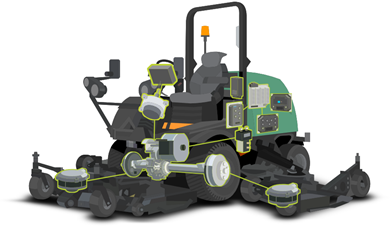
Momentum is building for pure electrification across a number of off-highway markets, such as construction, earthmoving and mining, where reduced noise and lower emissions are advantageous to the working environment. We’re seeing an increased adoption of electric excavators, compact loaders and mini diggers for urban environments, as well as electric haul trucks and underground vehicles. We’re also seeing companies experimenting with hybrid equipment before committing fully to electrification.
As with any innovation in the market, some companies go all in at the start while others will be more cautious and watch and wait to take advantage of lessons learned. This is also something we’re seeing when working with OEMs who are keen to manufacture equipment that is safer, more efficient and environmentally friendly, but don’t have the resources for the upfront investment that electrification requires.
We’re seeing this being addressed in the form of hybrid powertrains, a transitional step, where a combination of battery and diesel is used. And we’re working with OEMs to retrofit solutions to existing equipment. This enables older machines to make the electric transition without businesses needing to replace them – this may be the preferred route of many companies if/when legislation makes reducing carbon emissions a necessity.
Lancereal is proud to support OEMs with their transition to a greener, and quieter, manual handling solutions. Find out more here.
Operational Benefits of Powertrain Electrification
Being at the forefront of powertrain products and services, we’re seeing significant momentum building across several off-highway segments that we wanted to draw attention to. In particular, the greatest demand is where electrification delivers tangible operational benefits to the machine user.
Operational benefits
The reduction in noise and fumes, delivered through electrification, is a great boon to many industries where they are being challenged to demonstrate ESG (Environmental, Social and Governance). As it means equipment is no longer having to be solely powered using fossil fuels and the methods are more environmentally friendly. And the fact that combustion engines aren’t being used leads to an end of fumes being emitted.
This is something that is highly beneficial and sought after in mining environments, where we’re seeing an increasing interest for electric haul trucks and underground vehicles – which can also lead to a reduced cost in ventilation requirements and safer operations.
The reduced noise experienced from using electric motors and battery systems also has its benefits in construction and earthmoving, where there is a strong push for electric excavators, compact loaders and mini diggers in particular for urban environments.
Responding to environmental demands
When you consider the environmental and sustainable goals of organisations, electric does tend to be more favourable. But we’re seeing that even if an organisation doesn’t themselves have specific ESG goals, they are being driven by demands of the environments in which they operate. Key examples being ports and airports, which are energy intensive industries, and where making the shift to electric – in order to meet zero emission targets – is high on people’s agendas. In these areas the focus tends to be on forklifts and port equipment such as terminal tractors and reach stackers as well as e-tugs and electric vehicles for the transport of passengers.
And for similar reasons, within municipal services street sweepers, refuse trucks and utility vehicles are proudly leading the early adoption in public sector fleets.
Could hybrid be an alternative approach?
Whilst we’ve listed some of the benefits of electrification, it does pose some challenges in certain environments and solely may not be the right solution. For instance, in remote and temporary locations there may be a lack of charging infrastructure or more planning may be required to support this need.
A further consideration is the battery technology, which may not provide sufficient runtime for high-duty cycles and the charging of these could disrupt productivity in continuous-use operations. Additionally, the weight of the battery could increase vehicle weight resulting in a reduced payload capacity.
So, in response to some of these challenges we do work with customers where a hybrid approach is beneficial. This could be the use of biofuels, which are produced from renewable biomass sources and can be used as a transportation fuel when blended with petrol or diesel. It’s a common approach when an organisation is looking to reduce its emissions and dependency on fossil fuels. And when used with electrification it can support heavy-duty transport and enhance the overall efficiency of equipment and further accelerate the transition to electric.
What next for off-highway?
Thinking about some of the headway already seen in the off-highway sector and the reservations that still exist in going fully electric, there are more technologies and trends coming down the line that will impact the sector.
Research and development is ongoing around battery technology, with a focus on greater energy density, faster charging, and improved safety. As well as optimising power usage, based on real-time workloads and conditions.
Retrofit solutions are a key trend to enable older machines to transition to electric without full replacement which is cost effective and sustainable.
Reduced operational inefficiencies is a key driver too, as it supports more efficient energy use as well as utilising predictive maintenance.
And more broadly, the drive for electrification will evolve in the next decade or less as the electrification of mid- to heavy-duty equipment becomes more viable through improved battery ranges, with reduced downtime. There will also be increased pressure to go electric driven by regulation around the need for low-emission zones and delivering against sustainability goals. However, this should be made possible through wider ecosystem development such as on-site renewables, mobile charging and battery recycling.
Why work with a long-term electrification partner
As a systems integrator with experience in industrial and mobile equipment we are well positioned to be a long-term electrification partner to forward thinking manufacturers. From electric powertrains to control systems and software integration, we can support with end-to-end solutions. As well as delivering complete electrification packages for OEMs and retrofitters.
With decades of collaboration expertise, we leverage our strategic partnerships with motors, gearboxes and control system manufacturers to deliver integrated, ready-to-deploy solutions. And the long-term element of our partnership with you – we go beyond integration. Our experienced team can provide diagnostics, analytics, and aftermarket support for long-term reliability.
Get in touch with our team to discuss your next project.
After gathering comprehensive information about your vehicle or machine, the next crucial step in the electrification process involves optimising your electric powertrain design and ensuring that the selected components meet your operational requirements. At Lancereal, our focus on detailed analysis and precision engineering ensures that your electrified system performs reliably and efficiently, tailored to your specific application.
Running calculations to make precise recommendations
With the data collected during the information-gathering phase, Lancereal engineers begin by running a series of detailed calculations to evaluate the requirements of the electric powertrain. This step is essential to determine the right balance between performance, efficiency, and cost.
Accurate calculations of the torque and speed requirements are key to ensuring that the selected motor and gearbox can meet the vehicle’s operational demands. These calculations help identify the ideal motor size, gear ratios, and configuration that will allow the vehicle to operate at its peak performance while maintaining energy efficiency. The goal is to achieve optimal power output without compromising reliability or exceeding the system’s capacity.
Based on these detailed calculations, our engineers provide data-driven recommendations on the ideal components for your electric powertrain, including the best motor, gearbox, and control system to achieve your goals. These recommendations are tailored to your vehicle’s requirements and consider factors such as efficiency, cost-effectiveness, and component availability.
Powertrain Design and Configuration
With the analysis and calculations complete, the next step is to design the electric powertrain configuration that will bring your electrification project to life.
Motor Selection Choosing the right motor is critical to the success of an electrification project. Whether the vehicle requires a high-torque motor for heavy-duty applications or a more lightweight, high-speed motor for efficient mobility, Lancereal ensures that the motor’s specifications align with the performance requirements identified during the earlier analysis. Key considerations include motor type (e.g., permanent magnet, induction), efficiency ratings, and size constraints.
Gearbox and Transmission Configuration Choosing the right gearbox and transmission setup is crucial to achieving the perfect balance between speed, torque, and energy efficiency. At Lancereal, we ensure gear ratios are precisely matched to the vehicle’s operational needs, allowing the electric motor to perform within its optimal range.
Key considerations include the type of gearing, such as planetary, worm, or helical gears, which are chosen based on the specific application. The configuration, whether it involves wheel drive, shaft output, or axle setups, is tailored to the unique requirements of the vehicle. Additionally, braking (mechanical, electrical, or hydraulic) and disengage systems are carefully selected to enhance both performance and safety.
All these factors are evaluated with space constraints, efficiency, and cost in mind, ensuring a gearbox and transmission setup that integrates seamlessly into the overall powertrain design.
Control System Design Once the transmission selection is confirmed, Lancereal can help with choices on system architecture, matching the functionality requirements with the correct control system to suit the application. The control system governs how the electric powertrain interacts with the operator’s inputs and responds to varying load conditions.
Safety is also a critical aspect of control system design. Features like emergency stop functions, overload protection, and fault diagnostics are integrated to enhance operator and vehicle safety. By combining advanced functionality with robust safety measures, Lancereal ensures that the control system not only maximises performance but also provides peace of mind in all operating conditions.
CAD Design and customer collaboration
Once the electric powertrain design has been finalised, the next stage involves creating a detailed CAD (Computer-Aided Design) model to visualise how all components fit within the vehicle’s existing architecture.
3D modelling and simulation We use CAD modelling to ensure that all components integrate seamlessly within the vehicle’s physical constraints. This step is crucial for identifying any potential issues with space, weight distribution, or component accessibility.
Programmming Working with the customer to define the functional specification is key to the programming phase. Alongside gathering information about the powertrain, we also collect detailed insights into the machine or vehicle’s intended functionality. This helps us fully understand what the customer aims to achieve with the electrification project and identifies the level of support they may require.
With this understanding, we determine whether the project needs bespoke software development, such as custom programs, or if the in-built flexibility of the controller operating system can meet the requirements. Software development considerations also include integrating CAN (Controller Area Network) systems, ensuring seamless communication between components and achieving the desired functionality.
Customer collaboration Collaboration with our customers is a vital part of the process. We share detailed CAD models and datasheets to gather feedback, ensuring the design aligns with the customer’s expectations and requirements. Adjustments are made based on this input, guaranteeing that the final product is fully optimised before moving to the implementation phase.
A key step in this stage is defining the scope of works. This outlines the project’s deliverables, providing clarity for both parties and establishing a shared understanding of the goals, milestones, and responsibilities. Input from both sides is crucial during this phase, as it ensures the project remains aligned with the customer’s needs while adhering to the agreed timeline and outcomes.
By working closely with our customers, we create a seamless process flow for system integration, addressing every aspect from initial design to final implementation with precision and collaboration.
Implementation and optimisation
The final step in the electrification journey is to implement the designed electric powertrain system, followed by optimising the system for real-world use.
Component installation and testing Once the design is approved, components are procured, installed, and integrated into the vehicle. Our engineers work with you to conduct extensive testing, verifying that the powertrain meets all logic and performance criteria.
We can be as involved in this integration stage as much or as little as the customer requires. Depending on the project and customer preferences, we offer several approaches:
Integration Testing on In-House Test Rigs We conduct integration testing on our in-house test rigs, using the bespoke programming and selected hardware to ensure the system’s functionality meets expectations. The customer then takes responsibility for the full integration testing on their vehicle or machine.
On-Site Support for Integration Testing and Installation In addition to in-house testing, we can provide support at the customer’s location during integration testing and installation to ensure the system functions as intended.
In-House Full Integration For a complete service, we can bring the customer’s machine in-house and fully integrate the powertrain and control system into the vehicle or machine. This option ensures seamless alignment between hardware and software before delivery.
System optimisation After installation, the electric powertrain undergoes a series of optimisation tests to fine-tune its operation. While the responsibility for testing the vehicle or machine ultimately lies with the customer, we can provide ongoing support as needed.
This support includes:
the adjustment of parameters to ensure smooth, accurate operation
logging of performance data and review to check for improvements of hardware or control system
troubleshooting of functional operations to achieve optimal performance and address any challenges that arise during product development
Precision from start to finish
Electrifying a vehicle or machine is a complex process that requires meticulous planning, detailed analysis, and precision engineering. By following a structured approach—from comprehensive information gathering to detailed calculations, design, and implementation—Lancereal ensures that every electrification project delivers on its promise of efficiency, performance, and reliability.
With our expertise, you can confidently transition to electric power, knowing that each step of the journey is optimised for success.
Benefits of the electrification of mobile vehicles and machinery
The electrification of mobile vehicles and machinery offers significant benefits, including improved efficiency, reduced emissions, and enhanced control systems. However, your electric powertrain design requires careful planning and precision, starting with a thorough information-gathering process. For engineering teams, this stage is essential to ensure that the final solution meets the exact operational needs of the vehicle or machine.
Understanding the operational parameters of the system is key to designing an electric powertrain that will deliver the required performance. At Lancereal, this process begins with an extensive application questionnaire, aimed at capturing the unique specifications and challenges of the project. The data collected in this phase allows our engineers to tailor the electrification process to the machine’s exact needs.
Key areas of focus include:
Vehicle type and application
The nature of the vehicle or machine is one of the most important factors to consider, as the operational demands will vary depending on function. The environment in which the vehicle operates (e.g., off-road terrain or factory floors) and the duty cycles will influence the powertrain’s design and effect decisions around the most appropriate parts for the motor size to the control system.
Weight and distribution
The weight of the vehicle, including how that weight is distributed, has a direct impact on motor sizing and powertrain configuration. Heavier vehicles demand more torque, while uneven weight distribution may require more sophisticated control systems to maintain balance and efficiency across all wheels.
Wheels and surface interaction
Understanding how many wheels the vehicle has, and what surfaces it will be driving on, is essential. For example, vehicles that operate on rough terrain or with varying load conditions will require different torque outputs and drive systems compared to those used on smooth, even surfaces.
Technical performance specifications
It is important to gather data on the vehicle’s torque, speed, and power requirements. How fast does it need to travel? How much torque is required for acceleration or climbing inclines? This information ensures that the selected electric motor and gearbox can meet the vehicle’s operational demands without overloading the system.
Functional specification & Safety considerations
Getting a clear picture of how the vehicle or machine will operate is essential to ensure the control systems and programming are up to the task. This involves looking at not just how the vehicle functions but also how safe and user-friendly it is for operators. For example, in a wheel-drive application, we’d explore:
Speed Control: How is the speed managed? Does it need a throttle, fast/slow modes, or set speeds?
Steering Systems: What kind of steering does it have? Is it skid steering, electric power steering, or something else? Are there sensors to help monitor and control it?
Data Displays: Does the machine need to show things like battery levels, speed, or hours in use?
Hydraulics: Are hydraulic pump motors needed for functions like lifting or steering?
Battery Tech: What type of battery is being used, and how does that impact the system?
Safety Features: Are there requirements for emergency stop systems, overload protection, or operator alerts? These features are vital to ensure the machine operates safely in all conditions.
Operator Conditions: Will the vehicle be operated manually, remotely, or autonomously? If remote control is required, what kind of system is needed to ensure seamless and reliable operation?
By digging into these details early on, we can make sure the control systems are designed to work exactly as needed. It’s all about creating an electric powertrain that fits how the vehicle or machine is meant to work, making it as efficient and reliable as possible.
Why Information Gathering is Crucial
Accurate data collection is critical because it defines the framework for the entire electrification project. Without precise information on vehicle specifications, it becomes nearly impossible to design an electric powertrain that will function optimally. Incorrect or incomplete data can lead to underperformance, energy inefficiencies, or, in the worst cases, system failure.
It’s also important to recognise that with new machine designs, engineers often learn and adapt throughout the process, leading to new ideas and changes as the project evolves. Our role is to provide flexibility while ensuring effective change management every step of the way.
Tailoring the Solution
Every vehicle is unique, and so too are its power requirements. Gathering detailed information enables our engineers to run accurate calculations and select components that are specifically suited to the vehicle’s operational environment and tasks.
Safety is a critical consideration throughout this process. Different applications often come with specific regulations and standards that must be met, whether they involve vehicle performance, operator safety, or environmental compliance. By factoring these requirements into the design, we can create systems that are not only efficient but also fully compliant with industry and legal standards.
Operator comfort is another key aspect. From smooth controls to noise reduction and ergonomic design, a well-thought-out powertrain can significantly enhance the user experience. Whether it’s a vehicle being manually operated or one controlled remotely, considering the operator’s environment ensures the solution is practical, intuitive, and comfortable to use
Information gathering is not just the first step in electrifying a product – it’s the most important one. By investing the time to gather accurate, detailed information about a vehicle’s operational needs, Lancereal can ensure that the final electric powertrain solution is optimised for efficiency, performance, and reliability.
Through our comprehensive approach, we often uncover considerations that might not have been identified before, especially for engineers accustomed to working on combustion engine vehicles. Asking the right questions helps us address potential challenges early on, paving the way for a smoother and more effective electrification process.
Whether you are electrifying a fleet of vehicles or a single machine, the process starts with understanding the unique challenges and requirements of your application. Our structured approach to information gathering to provide data-driven recommendations ensures that your electric powertrain is built on a foundation of accuracy and precision, delivering long-term benefits in both performance and sustainability.